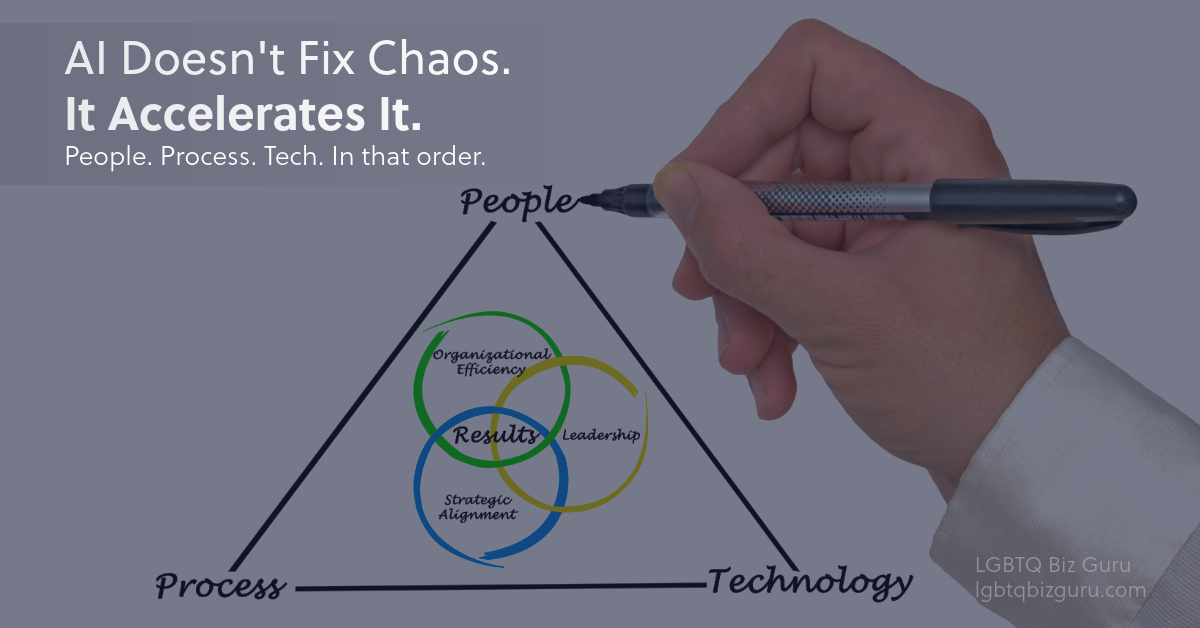
AI Doesn’t Fix Chaos. It Accelerates It.
AI doesn’t fix messy systems — it amplifies them. Here’s how small firms can tighten people, process, and tools so execution gets faster instead of noisier.

Why People, Process, and Tech still matter for small firms.
Far too often, People and Process are left out of the conversation in favor of “be all, end all” tech solutions. Buy this app, extension, or add-on, and it will solve all your problems. If only it were that simple.
I get it. The pressure is real. AI features keep rolling out, “agents” keep getting marketed like digital employees, and every platform promises faster work with fewer people.
But after spending the past 24+ months on the front lines of what I’ll call the Great AI Workforce Experiment, one truth keeps reappearing.
People, Process, and Technology are still three legs of one stool. AI, automation, and the like don’t replace that in small firms. They amplify it.
Small firms feel this faster than anyone. People still wear multiple hats. There is rarely a dedicated enablement team, rarely a true process owner, and rarely the bandwidth to “properly adopt” yet another new workflow layer while keeping day-to-day delivery moving.
So what happens in the real world? AI gets layered on top of workflows held together by muscle memory, tribal knowledge, and a few key people. When the foundation is unclear, the tool does not create relief. It creates drift: duplicated work, inconsistent outputs, missed handoffs, and confusion about what is done versus what is still pending. In some cases, workflows flat-out break.
The Real Impact
Here are three areas where rushed AI and automation deployment hit small firms hardest:
1) Client intake and handoff
Intake comes in through forms, referrals, DMs, and email. Each entry point creates a slightly different version of the truth. Details get retyped into a CRM, copied into a tracker, and sprinkled across threads and attachments. AI can speed up replies and summarize discovery, but if you have not defined what data must be captured and where it lives, you just accelerate the part that was never the real bottleneck.
2) Delivery and client communication
Delivery moves fast in small firms. Quick calls, Slack, inbox threads, “I’ll take it.” Meanwhile, the official tracker becomes optional, stale, or used differently by each person. AI can generate a clean client update in seconds, but if nobody owns task updates, decisions, and next actions, the update becomes a polished story that hides drift. Clients feel it when timelines slip and they have to repeat themselves.
3) Billing, time capture, and collections
This is where the money leaks quietly. Time entries come in late, billing narratives vary by person, approvals are inconsistent, and invoices go out without enough context. AI can help write clearer billing notes and summarize work performed, but it cannot fix weak time capture habits, unclear billing rules, or missing approval gates. If billing is loose, AI does not make it disciplined. It just makes it easier to produce output that still does not align.
📋 Underneath all of this is knowledge management
Templates, SOPs, and “how we do things here” usually live in too many places, and the best version is often in someone’s head. AI can remix what it finds, but retrieval only works when you have a system of record: naming conventions, owners, version control, and a clear place where it lives. Otherwise, you get something that sounds right, pulled from the wrong version, and pushed into production too quickly.
The Stability Triad for Small Firms
Here is the simplest way I know to evaluate whether AI is (or will) create leverage for your firm or accelerate the chaos. This is PPT in action as an operating reality, not a theory.
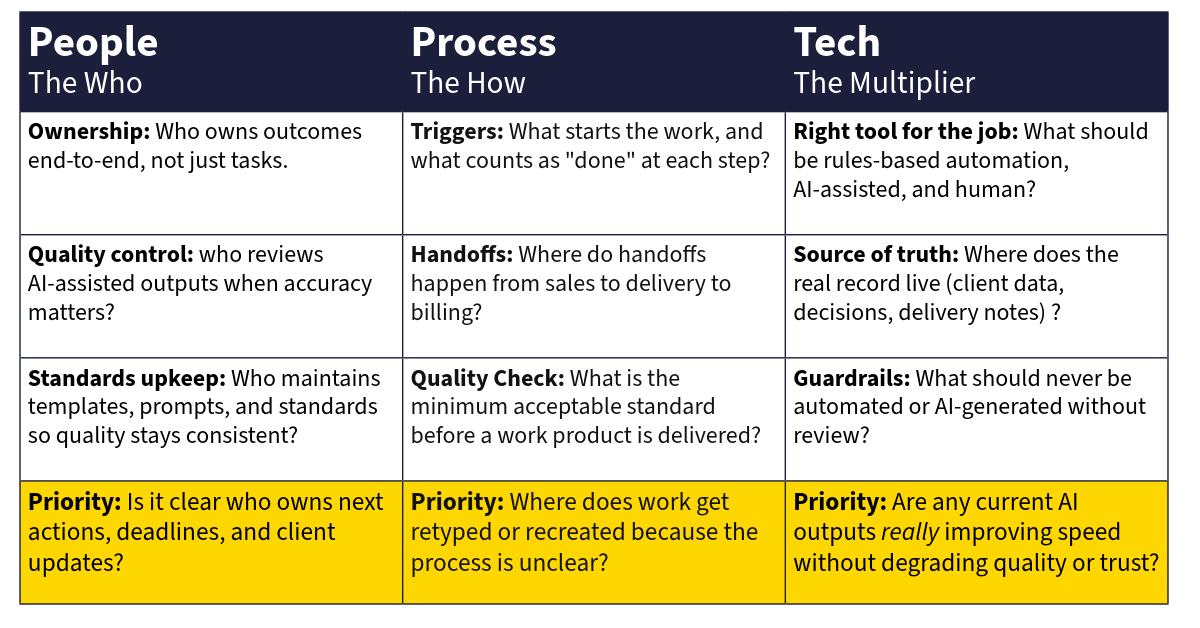
AI can draft, summarize, and categorize quickly. It cannot decide your standards. It cannot resolve unclear ownership. It cannot fix a workflow that was never stabilized.
Automation is not a magic wand either. If you automate a broken process, you do not remove friction. You push it downstream until it becomes rework.
This is what adoption leadership looks like in 2026. Not chasing tools. Creating an operating foundation where tools can actually help.
In the next article, I’ll break down the difference between automation, scheduled actions, integrations, and AI so leaders stop getting sold “AI” when they really need basic workflow control.
🤝 If you want help mapping one workflow, clarifying ownership, and deciding what to automate, AI-assist, and keep human centered, visit my page and lets chat.