2026: From AI Noise to Actual Leverage
2026 marks the shift from AI noise to real leverage. This piece breaks down what small firms must stop doing — and what to focus on instead — to get measurable value from AI.
How Small Businesses can Close the Execution Gap in the Era of Orchestration
TL;DR 📌
- 2025 was chaotic for AI adoption, especially for microbusinesses; 2026 requires meaningful adoption to stay relevant.
- The immediate shift outside Wall Street isn’t AI replacing people; it’s professional roles evolving to require “super producers.”
- Productivity gains (~20%) are attainable now, but realistic only when AI is integrated thoughtfully.
- The next phase of AI is about orchestration, judgment, and systems, not prompts.
- Businesses that invest in digital adoption now will scale; others will stall.
👉 If you want the context, examples, and what this means for your role in 2026, read on.
Phew. We made it to 2026!
If you’re a small business owner, especially a microbusiness or solo provider, 2025 was…. A LOT! AI uncertainty everywhere. Conflicting advice. Tools launching faster than anyone could keep up with.
Meanwhile, in the consumer and creator digital space, AI slop has run rampant, burying quality content and disrupting SEO, SEM, and the signals professionals have come to rely on.
And if you were trying to actually run your business while sorting through all of it? Yeah. I’m genuinely impressed you made it here with enough sanity to keep reading.
Take a breath. 😮💨 It is getting better.
A Front-Row Seat to the Reality 👀
Last year, I had a front-row seat to AI implementations across enterprise, small business, and personal spaces, and I shared a lot about what I saw.
Spoiler: It was messssyyy! 🤯 And here’s what that looked like on the ground:
- Leaders itching to integrate AI for AI’s sake, driven by big tech claims marketed as “ready” but clearly still in live beta.
- Big tech reps speaking in circles, dodging real questions when you drill down (the denial is fierce)!
- IT and strategy teams being asked to do the impossible while vendors were building the plane in flight
- And big consulting firm whitepapers effectively saying “ew” on the lack of cohesive strategy, yet being selectively ignored by those itchy leaders
The Smaller the Business, the Steeper the Hill ⛰️
For my microbusinesses, the climb was even steeper:
- Less vendor attention
- Fewer resources to upskill
- Hype baked into training materials
- Third-party education that was disjointed, contradictory, or just plain wrong
Many tried anyway, listening to puffed-up, prompt-hacking content hyping “new” tech that was often ChatGPT-4 in a prettier skin, then fumbling through a hodgepodge of ad hoc solutions used incorrectly, possibly compromising sensitive data along the way. 🙄
Others stayed in “wait and see” mode. Plenty likely quit quietly or only “played” with tools sporadically.
That could all be justified in 2025, but it will no longer suffice.
Toward the end of the year, though, something shifted. Not quite perfection, but stabilization and clearer business value in sight. Relief, especially for more nimble microbusinesses not tied down by large, complex enterprise ecosystems, where decision cycles are slow.
Where AI Actually Worked ⚡
At the same time, I saw what happens when AI is used well. When:
- The right tool is used for the right purpose
- Expectations are grounded in reality, so people can see the “magic” of AI as a whole and feel less threatened.
- Someone spends an hour or two up front laying tool-agnostic foundations, clearing misconceptions, and being honest about where AI is genuinely useful (and where it isn’t)
That’s when productivity jumps. It turns out pragmatism and small, repeatable wins had the biggest impact. Subject-matter experts on the front lines (outside of big tech) actually knew what they were talking about.
While it’s notoriously hard to benchmark cleanly and many claims are inflated, ~20% gains in text-based production and administrative automation are realistic when AI is paired with proven tech like workflows, scheduled actions, and integrated systems (the more native the better).
Strategically. Not haphazardly. That is the key distinction, and it matters. A lot. The experimentation window is closing.
How I Use AI Tools (no gatekeeping) 🤓
I fully own the strategy, judgment, and technical direction of my work. AI doesn’t “think” for me; it supports execution.
I iterate constantly and cross-check claims because conditions change almost daily. I’ll often share dense, “thought-cloud” writing to generate structure and surface gaps, then refine and reorganize from there. Sometimes the output is strong enough to heavily edit and enhance. More often, I’m pulling insights from it on one screen while writing in my own voice on the other.
I primarily work inside Google Workspace with Gemini, including a custom Gem built specifically for blogging, with explicit instructions and writing samples. I also work directly inside Docs, which often produces a slightly different, but useful, angle and summaries that help me gauge how effectively I’m communicating key points.
I still use ChatGPT Plus, specifically a Project that contains my brand content, as a secondary layer to refine language, stress-test ideas, and tighten messaging. The point is to write more effectively in a way that is responsive to the ever-evolving SEO landscape.
It may sound like a lot, but this is thought-heavy, forward-facing work. And while it unquestionably saves me time, I’d have zero credibility in this space if I relied on AI alone.
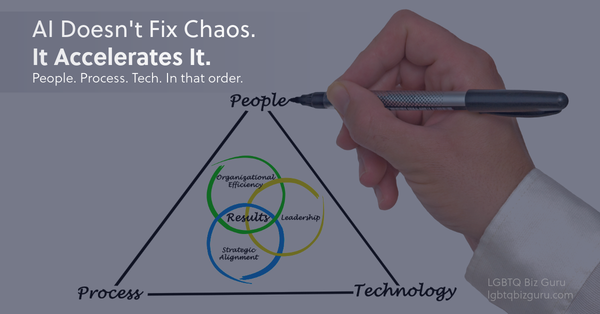
That’s the difference between using AI and adopting it well. Adoption is where strategy, systems, change management, and training actually meet.
AI Tools I’m Focusing on in 2026 (and Why) 🤖
For 2026, I’m reaffirming my focus on the deeply integrated Google Workspace with the Gemini (3) AI tool suite, with practical applications woven across the Six Critical Business Dimensions™.
Not because it’s perfect or trendy (I was on board well before the latest Gemini 3 hype), but because it’s integrated, persistent, and built from the inside out.
I’ve covered practical examples of Google Workspace + Gemini in action before, so I won’t rehash them here. Familiar tools like Gmail, Drive, Docs, and Meet, connected natively to Gemini chat, consistently save the average small business professional 2–4 hours per week in administrative and coordination work right now with proper training and use. Check out my blog archive for more on that.
But beyond the immediate gains, and what really matters in 2026 and beyond, is agent scalability, and this suite helps you compound gains:
- Custom Gems act like lightweight, user-created agents that retain context and support repeatable workflows
- Scheduled Actions enable early agent-like behavior (recurring summaries, prep work, coordination) without technical overhead
- Workspace Studio (rollout in process) signals where cross-tool orchestration is headed — bringing agent-style automation closer to everyday users, not just developers
I’m also excited to see how this evolves as platforms like QuickBooks + Intuit Assist, HubSpot + Breeze AI, and Notion AI, all with meaningful Google Workspace integrations, continue maturing in parallel. That convergence will be a force multiplier for microbusinesses that adopt intentionally.
This ecosystem scales with microbusinesses instead of forcing them to replatform every 12–18 months. That’s the difference between growth and stagnation.
As these systems mature, the real opportunity is when they can begin talking to one another, sharing deeper context across finance, operations, marketing, and knowledge work, without businesses having to stitch everything together manually.
That’s the direction I’m building for and the type of conversation I have with clients when we’re looking at the full picture, not just one piece of the puzzle. Because the complexity and cost of other integrated systems often make them a non-starter, and AI is far less useful with a bunch of siloed apps.
Closing Thoughts & My Focus for 2026 🧐
If 2025 was the year of noise and confusion, 2026 is the year of execution and adoption.
So allow me to reintroduce myself: I’m your Digital Adoption Manager — helping microbusinesses and professional service firms turn AI from curiosity into something practical, repeatable, and scalable.
Not chasing tools. Not reacting to hype. Just building systems that are ready for what’s next.
That’s where I’m spending my energy. And that’s who I’m here to help.
Ready to Future-Proof?
📆 Click Work with me and schedule the advisor that is best for you.