The Core Four Challenges LGBTQ+ Business Owners Face — And Why Solving Them Together Matters
LGBTQ+ business owners face recurring challenges that quietly slow execution and drain momentum. This breaks down the core issues—and why solving them together matters for durable growth.

The Core Four Challenges LGBTQ+ Business Owners Face 😬 🏳️⚧️
…and how we can unite like never before to solve them.
Last week, I made the case for why LGBTQ+ entrepreneurship is more important now than ever, whether as a solo provider, small team, or traditional small business. It is one of the most empowering endeavors you can take to become part of a greater economic, cultural, and social force.
It’s my hope that queer-owned and operated businesses start aligning like never before. That we build a Renaissance of Resilience, an era where our creativity, leadership, and inclusive values make it far too difficult for anyone to even contemplate coming for any of us ever again because of who we love or how we identify.
But running a business right now is especially hard, and I know if we’re going to rise together, we’ve got to tackle the challenges head-on. The unfortunate reality is that LGBTQ+ business leaders face many of the same struggles as everyone else, but often with fewer safety nets and an added layer of complexity that people outside our community don’t always see.
So let’s talk about what we’re really up against, not just to sip tea with one another and commiserate, but to rally, strategize, and start resolving them together.
#1 Differentiation in a Saturated, AI-Powered Market
I think the word is out that it’s never been easier to create content. The problematic trade-off is that it has never been harder to be seen, especially when flashy creators who are 95% hype manage to hack the algorithm and dominate the scroll.
But, guess what? Views and likes still don’t pay the bills. Client alignment is what matters. Loyalty = Retention & Referrals = Stronger ROI with Less Hustle. Once you find your niche and start to build momentum, that is.
Anywhere from 70–80% of people are still relationship buyers who are willing to pay a reasonable premium for personalized service. These are the clients you want to attract, so you can eventually reduce your marketing spend.
So yeah, in many industries you need to play the social media game and play it well as part of a larger strategy. To get there, you need clarity around your brand voice, offers that match your audience’s needs, and a digital presence that builds high-impact funnels based on trust and value. Which, surprisingly, remains at the top of the list for most consumers.
💸 The Added Cost of Being Queer
For LGBTQ+ folks there is an added question and issue: How visibly queer do I want to be and can I be in my branding? The angst this can cause cannot be understated!
And I’d love nothing more than to say “just be 100% unapologetically you” in everything you do. But I also know that depending on your industry, region, or anchor clients, that choice can impact how you’re perceived and how profitable your business becomes. You’re no good to anyone when treading water or going bankrupt.It’s a tightrope. An unfortunate one. An unfair one. One that is strategic, emotional, and deeply personal.
One thing I always advise is to position yourself in a way that honors your truth and supports your goals. How you lead and exemplify your internal values in your interactions and decision-making is what will shine through, with your increasing success giving you the platform to make a real impact. This is one of those things that doesn’t fit neatly into a template. It’s contextual and needs proper exploration; you deserve support from someone who understands those stakes.
#2 Not Enough Time in the Day to Get it All Done
Probably sounds familiar to just about everyone. Most small business owners I know are stretched thin. Days are a blur trying to keep existing clients happy, convert prospects into new customers, manage invoices, coordinate with vendors, handle administrative tasks like email management and scheduling, and still produce core work products while finding time for strategic, value-added work that grows the business.
Many LGBTQ+ business leaders often find themselves dealing with these matters without any sort of safety net. Seldom are we fine-tuning and growing a family-owned business; rather, we often start from scratch. Not only that, but finding quality vendors and talented service providers with whom we are comfortable doing business is an added challenge. Even the candidate pool can shrink. I think it’s fair to say we’re more often in a position to bite our tongue than others in dealing with the very folks we are the ones paying. And that’s just the male business leaders. Females and those who identify outside the binary often find things that much more difficult.
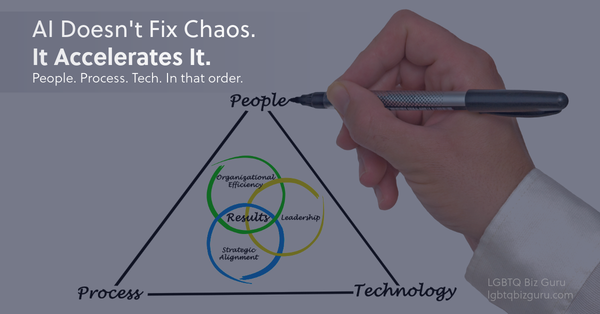
That’s one of the reasons I have become so fixated on AI, given its position as an equalizer and force multiplier. Because of the added barriers we collectively face, it’s all the more impactful WHEN USED STRATEGICALLY. I discuss this topic in greater detail in my AI Strategy Guide. Big takeaway: Given the additional challenges faced in this arena, it’s even more important that your tech and processes do all the heavy lifting, because we have so many other factors to contend with that can inhibit growth.
#3 Attracting Aligned, Profitable Clients
For a lot of folks just starting out, any prospect that engages and converts feels like a good client. I get it. But, no. Choosing your clients is totally a thing…a very smart thing to do, within reason.
The right clients respect your expertise, trust you’ll deliver, and seldom try to negotiate price, unless strictly around the margins to fit their budget. The wrong clients will laser focus on price regardless of value, then turn around and question every little thing, while blowing up your phone or inbox with constant questions and needless complaints. The right clients reward you with repeat business and referrals. The wrong clients will go out of their way to one star when you grow tired of the very antics I just mentioned. You get the idea.
Of course, folks in our community have to deal with that on top of matters of mutual respect and common decency. For starters, 70% of the US population believes L-G-B folks should have equal rights, which in and of itself was a miraculous feat. Which still means just shy of 1 in 3 people we may encounter don’t. And when we encounter these people, we feel it, and it sucks. It's just a matter of how vocal they are in expressing their distaste for us as people, which is an unknown variable that makes many feel apprehensive or unsafe. Needless to say, our Trans siblings and other fellow humans in our community who don’t fit neatly into the “M or F” categorizations, who have had every aspect of their existence, from bathrooms to healthcare access to military service to participation in athletics, publicly dissected, inevitably run into even worse challenges.
Finding quality clients is hard enough, and that additional layer that even folks in more “progressive” areas have to deal with is an unfortunate reality that requires a steady hand to navigate. Some can be overcome with frameworks that improve the likelihood of more successful conversions with fewer unnecessary run-ins with crazies. Sometimes, a little training on how to handle those gracefully in the moment can help. Sometimes, just having someone safe in the business community to talk to can be helpful. Hell, running a simple, targeted, small-scale Facebook page awareness ad recently resulted in a comment that all gays should be sent to Iran. This is even more reason we need to support and uplift one another, so we can be one of those profitable clients to one another.
#4 Code-Switching Drain and Emotional Labor 😣
I mentioned some of this when discussing the other three challenges, but it deserves to be explored further as its own topic. This one is more of the silent killer of business growth and performance…
From choosing whether to brush off or address microaggressions to subtle exclusion to the mental gymnastics of reading the room for a number of indicators, many LGBTQ+ leaders are constantly filtering themselves to protect client relationships, maintain professionalism, or just feel safe. One such common example is deciding whether to say “husband/wife”, “boyfriend/ girlfriend”, or the slightly more ambiguous“partner” during those natural small-talk interactions. It's an exercise many aren’t burdened with… checking for those awkward shifts in expression, tone, or body language before carrying the conversation forward. Or perhaps we avoid that sort of talk altogether, putting up artificial barriers and making us seem less approachable.
The point is, despite remarkable progress toward acceptance, it’s often not about knowledge, skills, and abilities. It’s about bro culture and connections. Ladies uplifting ladies, but only if they were born with the lady parts (ones life journey be damned). It's why so many LGBTQ+ folks often avoid putting themselves out there. And it's why those of us who do have often developed this quasi-perfectionist mindset to our detriment, because we have to be better than our straight counterparts to even compete. And even still, it might not be enough. Even still, if the hard work does pay off, we may be labeled a DEI choice.
All of this is excess energy we’re not spending on creativity, growth, or actual execution because capacity is a thing and its friggin’ exhausting. And that emotional drain is a real and quantifiable business issue.
🔑 Bringing it All Together
Every entrepreneur, regardless of their sexual orientation or gender identity, faces similar challenges. Only for LGBTQ+ folks, there are added societal barriers we have to either plow through or navigate around. None of these problems is fair, and none are fixable overnight. And I’m certainly not positioning myself as the solution to any of them on my own. At best, I can help you navigate and mitigate some of them. But here’s what I know for sure:
- ✅ Queer Entrepreneurship is empowering and still beats the alternative… at best being beholden to soulless corporations that only care about the community when it's fashionable.
- ✅ When we identify the issues and work through them as a community, we’re better equipped for success because we stop internalizing them and have the tools to work around them.
- ✅ When we build systems that align with who we are, thoughtfully and strategically, supported by community and technology, the burdens get lighter, and we become more successful.
- ✅ When we support each other strategically — not just symbolically — we all rise.
If we want LGBTQ+ businesses to thrive, we have to be honest about these obstacles — and intentional about how we move through them.
If you’re ready to align your brand, systems, and client strategy to reflect who you really are, I’m here when you’re ready! Until then, thanks for reading, following, sharing, and liking this content.